
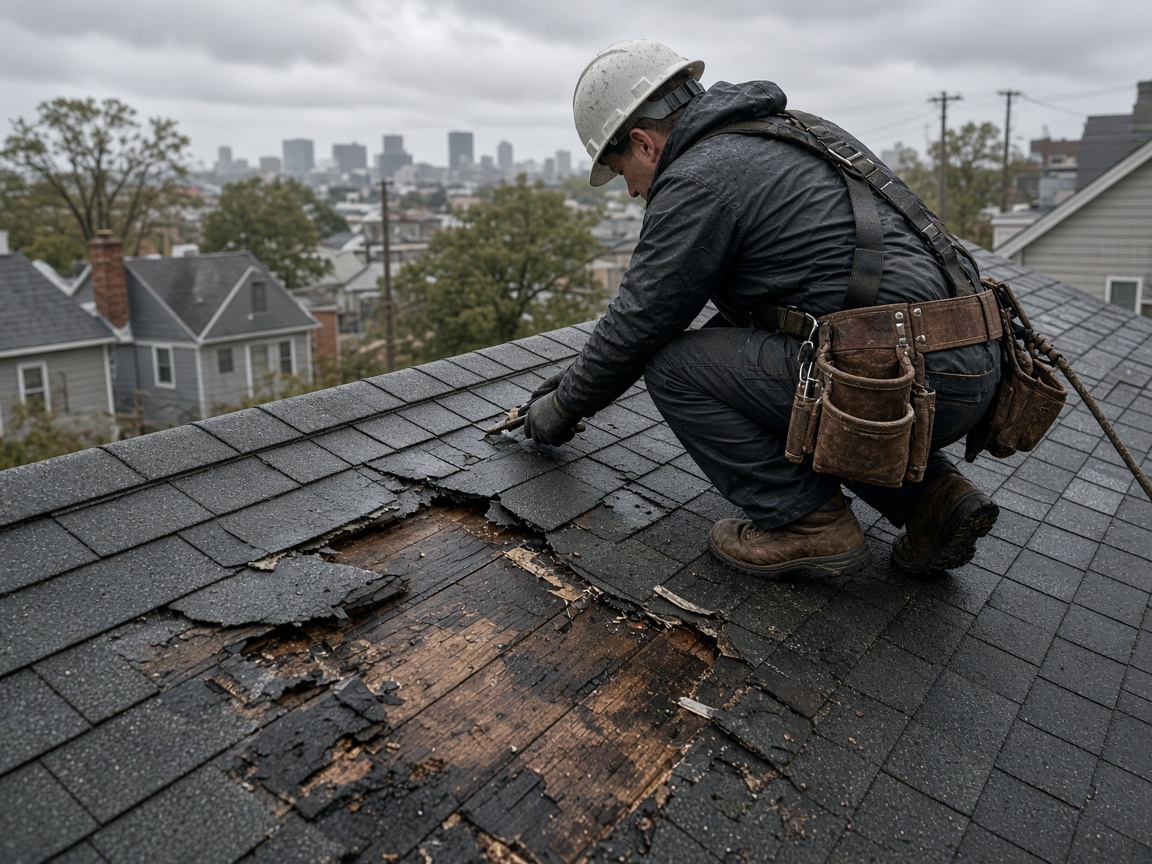
Newark's humid subtropical climate brings sudden summer thunderstorms and winter nor'easters that drive wind under older asphalt shingles common on two-family homes in the Ironbound and North Ward. Once wind lifts a few courses near a ridge, water follows the sheathing seams straight into the attic, especially on the steep pitches found around Branch Brook Park. We start every job by walking the roof with a moisture meter rather than relying on visual checks alone, because hidden saturation in the felt underlayment often extends two courses beyond the obvious tear.
Many Central Ward and South Ward properties still carry original slate or early asphalt layers installed before the 1970s that crack under hail rather than dent. When a storm drops ice larger than a quarter, we map each impact with chalk and photograph the granule loss so insurance adjusters see the pattern clearly. In Vailsburg and Weequahic, mature trees along the streets drop limbs onto low-slope additions during high winds; we remove the debris first, then check for crushed flashing at the wall intersection before any patching begins.
Heavy rain after a storm often reveals failed step flashing around chimneys on University Heights row houses where mortar joints have loosened over decades. We replace the flashing with wider copper or lead-coated copper rather than reusing the old pieces, because the original width no longer meets current Essex County wind-uplift expectations. Homeowners in nearby Elizabeth and East Orange frequently ask about temporary tarps; we install 10-mil reinforced polyethylene with furring strips screwed into rafters so the cover stays put until permanent repairs can be scheduled around work hours at 1 Gateway Center.
Technician insight
In Newark the thing that catches most people out with storm damage roof repair is how quickly water travels under the old felt on 1920s–1940s homes in the Ironbound once a single ridge shingle lifts; the leak shows up two rooms away from the actual damage, so we always check the entire attic before quoting.
Limb strike on Vailsburg two-family
A nor'easter dropped a maple limb across a low-slope rear addition in Vailsburg. We found crushed flashing and two feet of saturated sheathing extending under the main roof. After removing the limb and debris we replaced the sheathing section, installed new copper flashing, and added extra ridge vents to improve drying.
Storm Damage Roof Repair Services We Offer
✓Wind Uplift Shingle Repair
Re-secures lifted shingles and replaces damaged underlayment on Newark two-family homes after high-wind events common in winter storms.
✓Hail Impact Assessment
Maps granule loss and cracked slates on older roofs in the Ironbound and Weequahic neighborhoods after summer hail.
✓Emergency Storm Tarping
Installs reinforced temporary covers over active leaks near Prudential Center and Newark Penn Station properties within hours of a call.
✓Tree Limb Damage Repair
Removes fallen branches and restores crushed flashing on low-slope sections typical of Vailsburg and University Heights homes.
✓Chimney Flashing Replacement
Replaces corroded or displaced step flashing around chimneys on Central Ward and South Ward row houses after heavy rain.
Storm Damage Roof Repair Cost in Newark, NJ
| Service | Typical Range | What Affects It |
|---|---|---|
| Emergency tarping | $350–$650 | Size of area and height of roof |
| Shingle section repair | $450–$1,200 | Number of squares and underlayment condition |
| Hail impact patching | $600–$1,800 | Slate versus asphalt and number of impacts |
| Flashing and chimney work | $550–$1,400 | Access and extent of water intrusion |
Ranges are typical for Newark, NJ and confirmed with an exact written quote before any work starts.
How it works
- 1
Initial Site Walk
We inspect the roof, attic, and surrounding trees from the ground and roof level, noting wind direction relative to Newark's prevailing storm paths.
- 2
Moisture Mapping
A meter locates saturated sheathing beyond visible damage so repairs cover the full affected area rather than just the obvious hole.
- 3
Material Match and Repair
We source matching shingles or slate from local suppliers and reinstall with upgraded fasteners rated for Essex County wind loads.
- 4
Final Leak Check
After repairs we run a controlled water test and photograph every seam before leaving the property.
Pricing
Most storm damage repairs in Newark fall between a few hundred dollars for small patches and several thousand when multiple slopes or underlying sheathing require work.